Last Updated on July 8, 2026 by Yasser Mercate
Look at the two photos below.

Which person, do you think, is smarter? More awkward? Looks like they eat lunch alone?
Okay. Now take a look at these photos.

Which person looks more fun? Cooler? Groovier?
If your answer to both pairs of pictures is “the person with the glasses,” then congratulations: cinema has successfully rewired your brain.
In the 131 years films have been around, the way they tell stories, their language, has changed dramatically.
Early cinema did not invent its symbols from nothing. It borrowed them from the society watching. A hat could suggest class. A cigarette could suggest danger or glamour. A uniform could suggest authority. A pair of glasses could suggest intellect, awkwardness, discipline, or distance.
At first, film reflected the world outside the theater. Then, through a century of stories, it began to reinforce that world.
Over time, frames stopped being neutral objects on a face.
They became character evidence.
Just as frames themselves are diverse, so are the characters who wear them. The two types of eyewear, eyeglasses and sunglasses, have vastly different character connotations.
One invites the audience to look closer, while the other keeps something deliberately out of reach. Together, they form two very different dialects in the filmic language of frames.
Before we get into these archetypes, it is worth saying that we are talking about stereotypes in film, not real people. These are patterns cinema has used to build characters quickly, sometimes cleverly, sometimes lazily, and often with assumptions worth questioning.
Eyeglasses: The Flag of The Flawed
Eyeglasses are a medical necessity for the visually impaired. It’s that fact that associates eyeglasses with “defectiveness”. That idea can bleed into a character’s identity. They might be framed as socially defective, romantically defective, physically defective, or simply out of step with the world around them.
This brings us to arguably the most common trope with a character in glasses:
The Nerd
The nerd is the character marked by social misalignment.
Not always the smartest person in the room. Not always the most capable. The defining trait is that they do not pass smoothly through the social world around them.
They stand too stiffly. Speak too earnestly. Want too visibly. Their clothes feel practical in a world that rewards style. Their timing lands a second too early or too late. They are present, but not fluent.
This is where eyeglasses become such a useful filmic sign.
On the nerd, glasses make difference visible. They draw attention to the face, especially the eyes, but they also make the character seem easier to judge. The frame becomes a quiet announcement that this person sits outside the usual flow of charm, confidence, and social ease.
The nerd wants entry into the room, but the glasses tell us the room has already made up its mind.
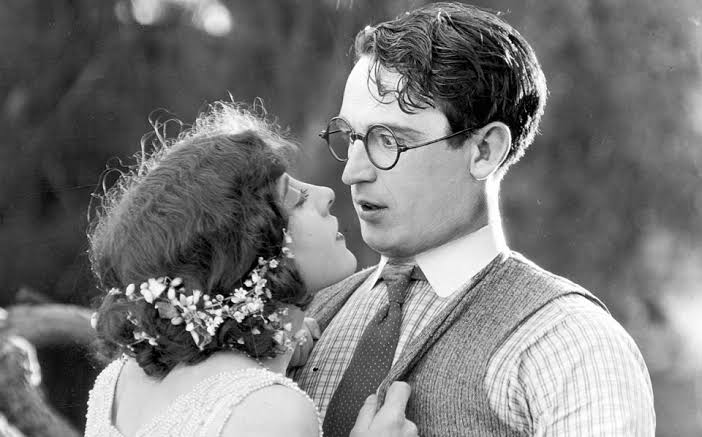
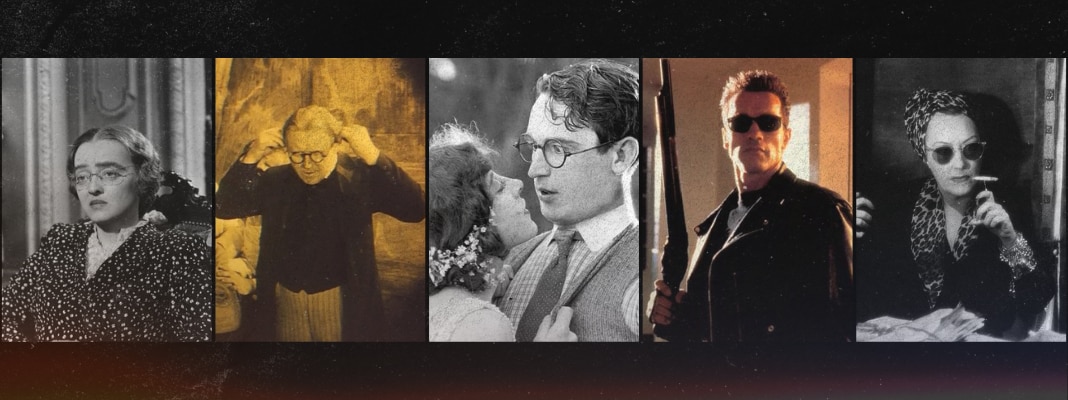
In Girl Shy from 1924, that misalignment appears as bashfulness. Harold Meadows is not a modern comic-book-store stereotype or a campus outcast. He is a timid romantic, a man who can imagine love more easily than he can perform it. His glasses help make him look careful, gentle, and exposed, as if he has rehearsed life in private but becomes overwhelmed when the real scene begins.
That is one of the oldest forms of the nerd archetype: the shy outsider trapped between desire and hesitation.
The character wants the same thing everyone else wants, but the social language does not come naturally. His glasses do not make him ridiculous by themselves. They make his nervousness easier for the audience to read. They place a small frame around a face already struggling to manage the world outside it.
In Revenge of the Nerds, the archetype becomes more openly social. Nerdiness is no longer only a personal awkwardness. It becomes a category, a visible position within a campus hierarchy. The athletes and popular students occupy the world of bodies, volume, confidence, and public space. The nerds are pushed toward the opposite end: awkward clothes, strained posture, nervous energy, and faces marked by frames.
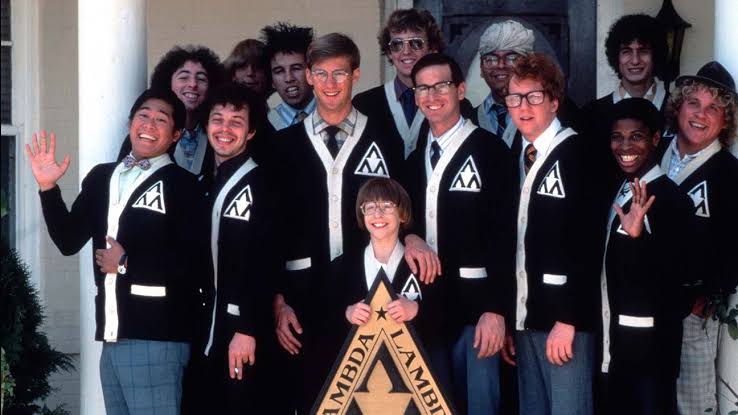
The glasses here work as part of a group language.
They help the film sort bodies quickly. Before any individual nerd has much room to complicate himself, the audience already knows where the campus has placed him. He is not excluded by accident. He is named, classified, laughed at, and kept at a distance.
That is the crueler side of the archetype. The nerd is visible, but only through a narrow reading. The glasses help make that reading immediate.

With Fogell/McLovin, in Superbad, the nerd becomes a figure trying to escape his own evidence. His fake ID announces a fantasy of adult confidence, but his face refuses to cooperate. The name says McLovin. The glasses say school hallway. The performance says danger. The expression says panic.
The comedy comes from that split.
Fogell wants to be read as older, cooler, and more sexually assured than he is. The glasses keep pulling him back toward the awkward boy beneath the performance. They interrupt the fantasy before it can fully settle.
This is the nerd as failed actor of coolness.
Across these examples, the glasses point to different pressures inside the same archetype. Harold Meadows gives us bashfulness. Revenge of the Nerds gives us social exclusion. Fogell gives us a failed reinvention.
In each case, the glasses do not create the nerd. They speed up the audience’s reading.
They tell us that this character will struggle with ease, status, desire, or belonging. The frame becomes a sign of exposure. It makes the face feel readable before the person has been understood.
That is the ironic cruelty of the nerd archetype. The nerd is not unseen. He is seen too quickly, through a frame that the story has already taught the audience how to judge.
The Scholar
The scholar sits close to the nerd, but the two are not the same.
Both figures belong to the world of the mind. Both suggest study, knowledge, and a slight distance from ordinary social ease. The difference is permission. The nerd is marked as awkward because of that distance. The scholar is granted authority through it.
That does not mean the scholar always escapes awkwardness. The Nutty Professor proves the overlap. Professor Julius Kelp, and later Sherman Klump in the 1996 version, still carry the familiar signs of the brilliant but physically unsure academic: nervous gestures, social discomfort, a body that does not move with leading-man confidence. The glasses fit that image neatly.
However, the scholar is larger than the bumbling genius.
Once film places intellect on a character, it can attach many other qualities to it: suspicion, grace, secrecy, restraint, technical command, moral distance, even violence. Glasses help sort those differences. They do not simply tell us that a character knows things. They tell us what kind of knowledge we are looking at, and whether that knowledge should comfort us.
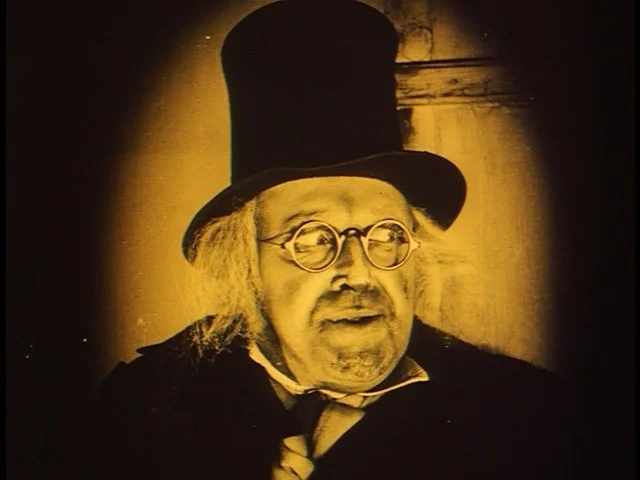
That is why Dr. Caligari, in The Cabinet of Dr. Caligari, feels so different from the comic professor. His glasses do not make him endearing. They sharpen the unease around him. He belongs to the darker scholar tradition: the doctor, the authority figure, the man whose learning gives him power over others. Through him, scholarship becomes clinical, controlling, and strangely inhuman. Knowledge does not soften him. It separates him.
That darker version matters because the scholar archetype has always had two faces. One is wise. The other is dangerous. The scholar sees more than others, but film keeps asking what kind of person emerges from all that seeing.

Professor Indiana Jones makes that question almost playful. In the university setting, his glasses help place him inside the classroom. They belong to the lecturer, the archaeologist, the reader of ancient texts, the man with institutional credibility. Once he leaves that space, the glasses disappear, as if his eyes have magically become perfect the moment he enters the adventure.
The shift is funny because it is so blunt. The glasses belong to one version of him, not the whole man. They mark scholarship as a role he can put on in the lecture hall and leave behind in the field. The film lets him learn, but it does not let the glasses follow him too far into danger. The frame belongs to the world where knowledge is taught, not the world where knowledge is chased.

Dumbledore, in the Harry Potter films, belongs to a softer scholar tradition. His half-moon spectacles do not make him look awkward. They make him look removed from ordinary panic. The frame gives his face a gentle distance, the look of someone who sees several layers of a situation at once and chooses, carefully, how much to reveal.
His glasses turn knowledge into patience. They suggest a person who has studied not just books and magic, but fear, loyalty, weakness, and choice. He is not comic because he knows more. He is calm because he knows more, and the calmness itself becomes part of his authority.

Q, in Skyfall, Spectre, and No Time to Die, brings the scholar into a colder modern register. His glasses suit a character whose power comes from systems: surveillance, weapons, code, data, tracking, and encryption. He is young compared with the older mentor figure, but his knowledge gives him access to rooms where power is designed.
The frame makes him exact rather than old-fashioned. Q does not need physical dominance to hold authority over Bond. His intelligence is practical, dry, and quietly superior. He sees the world as a set of systems, and he knows where those systems break.
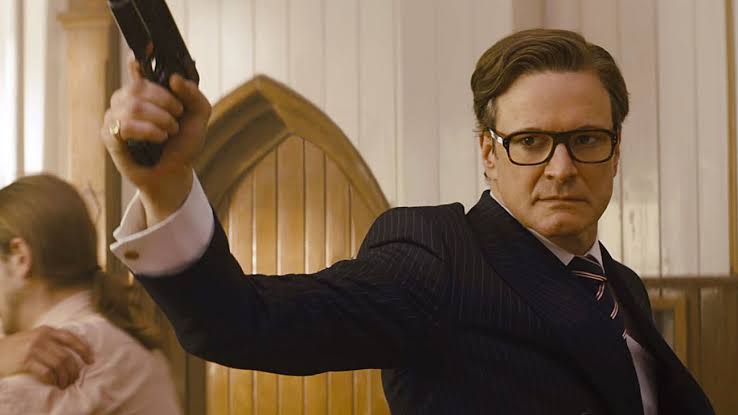
Harry Hart in Kingsman moves the scholar into elegance and danger. His glasses are part of a controlled surface: suit, manners, diction, posture, without being decorative. They belong to a character whose refinement is also a weapon.
Harry can read a room, read a threat, read a person’s weakness, and move before anyone else understands what has changed. The glasses make him look civilized, while the body beneath them remains deadly. In him, the scholar is no longer passive. Thought has become choreography. Taste has become a discipline. The gentleman and the assassin occupy the same frame.
That is the range of the scholar archetype.
The same visual sign can belong to the comic professor, the sinister doctor, the wise mentor, the technician, the gentleman spy, or the detached creator. What changes is not the presence of intellect, but its emotional temperature.
The nerd’s glasses expose social discomfort.
The scholar’s glasses give knowledge a face.
Sometimes that face is kind. Sometimes it is strange. Sometimes it is graceful. Sometimes it is frightening. But in each version, the frame tells the audience that this character’s power begins with how they see, study, and interpret the world.
The glasses do not simply say the character knows something. They make us look at what knowledge has done to them.
The Transformation
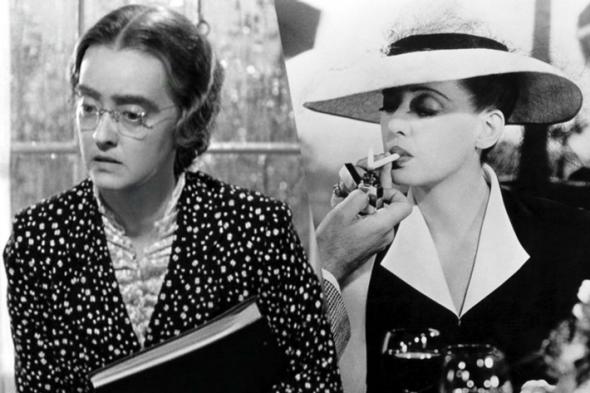
In the transformation archetype, glasses are treated like a cocoon. It uses the Nerd archetype as a thematic starting point, borrowing its awkwardness, social distance, and supposed undesirability, then turns the removal of the frame into a moment of arrival.
The character is suddenly allowed to become beautiful, confident, romantic, socially visible, or, in a more ironic sense, “who they were always meant to be”. Thematically? The character has not changed as much as the scene pretends. The glasses simply gave the story something to shed.
The glasses belong to the first version of the character: the version before romance, before confidence, before social approval, before the reveal. The framed face becomes the “before” face, a visual draft that the story intends to revise.
This is one of cinema’s most persistent habits. Glasses are placed on a character to signal that beauty is present but not yet legible, that charm exists but has not been properly styled, that the person is waiting for the right visual permission to be admired.
The strange part is that the face rarely changes as much as the story insists.
Charlotte Vale in Now, Voyager, Laney Boggs in She’s All That, and Mia Thermopolis in The Princess Diaries all belong to this tradition. Their glasses help place them on the wrong side of desirability, not because the frames truly hide them, but because the films rely on an old visual code: a woman in glasses can be treated as unfinished until the story decides otherwise.

The removal of glasses then becomes part of a ritual.
Hair is adjusted. Clothing is changed. Posture is corrected. The camera softens. Other characters look again.
The transformation feels personal, but it is also cultural. It reveals the beauty standard of the film’s moment. In older Hollywood, the polished woman often had to appear composed, elegant, and socially trained. By the late 1990s and early 2000s, teen cinema translated the same pattern into school hierarchy: the artistic girl, the awkward girl, the invisible girl, all waiting to be made readable to the popular gaze.
Laney’s glasses do not prevent her beauty. They help delay the film. Mia’s glasses do not prevent her from being royal. They help mark her as not yet compatible with the image of royalty. Charlotte’s glasses do not make her unworthy of love. They belong to a face that has been shaped by repression, judgment, and a life spent under correction.
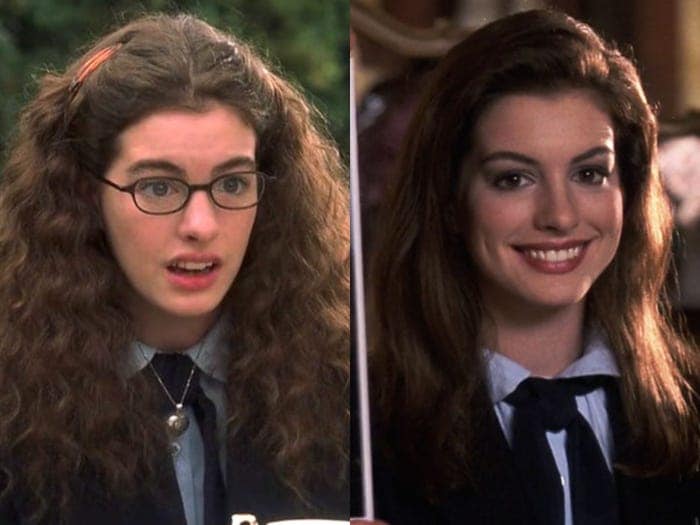
In each case, the glasses are treated as something the character must move beyond.
The story asks the audience to believe that the person in glasses is not the final version. The bare face becomes the reveal, as if beauty only becomes real once the frame disappears. But glasses are not a cocoon.
They do not delay womanhood, desirability, maturity, or selfhood. They only become one when cinema needs a clean visual symbol for everything a character is expected to outgrow.
This is where the makeover trope becomes revealing. It tells us less about glasses than about the gaze surrounding them. The “ugly girl” was rarely ugly. She was styled outside the accepted image of beauty, then reintroduced once the film had made her easier to admire.
The frame was never the problem. The terms of recognition were.
It is no accident that this archetype is most often attached to women. Film has been far more willing to treat a woman’s glasses as something standing between her and desirability. For men, glasses can signal intellect, authority, eccentricity, or disguise.
The same logic changes shape in secret identity stories, almost in the opposite way. Here, glasses are no longer the shell a character must escape; instead, the specs provide a cover-up or facade the character escapes to.
Clark Kent is the most famous example because the disguise is almost offensively simple. His glasses do not truly hide his face. They hide his category. As Clark, he becomes mild, polite, and easy to underestimate. As Superman, he becomes impossible to ignore. The glasses work because people do not expect power to arrive softly.
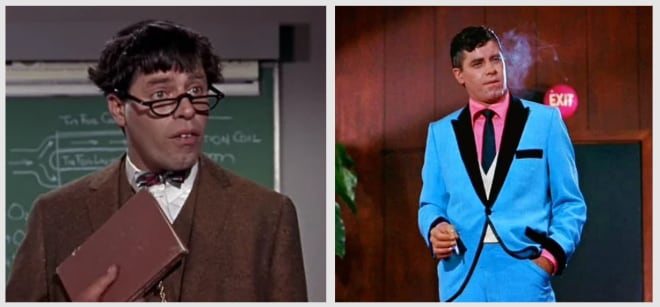
Professor Julius Kelp in The Nutty Professor uses glasses in a more divided way. They belong to the shy, restrained, socially embarrassed self, while Buddy Love appears as the fantasy of escape: louder, smoother, more forceful, more desired. The glasses do not cause Kelp’s insecurity, but they help organize it visually. They sit on the side of hesitation, while the unframed alter ego performs confidence as spectacle.
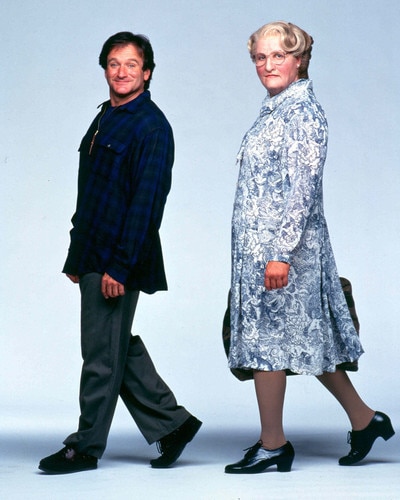
In Mrs. Doubtfire, Daniel Hillard’s glasses become part of a different kind of performance. As Mrs. Doubtfire, the frame helps produce trust. It supports the appearance of age, gentleness, domestic order, and safety. The disguise works because the glasses help make the invented identity feel familiar enough to welcome.
Across these stories, glasses shift between two related functions.
They can be treated as the “before” image, the thing removed, so a character can be admired. They can also be used as a facade, the thing added so a character can move through the world unseen.
Both uses depend on the same cinematic belief: a frame can change the social meaning of a face.
Take the glasses off, and the supposedly hidden beauty appears. Put them on, and the god becomes a reporter, the anxious professor becomes contained, the father becomes a stranger trusted inside the home.
The transformation is not really in the eyes. It is in the assumptions around them.
Sunglasses: Concealing the Character
Where eyeglasses announce a character’s difference, sunglasses conceal it.
They hide the part of the face that film wants most: the eyes. Without the eyes, a character becomes harder to read, harder to soften, and harder to place. The audience can still look at them, but it cannot fully look into them.
That concealment gives sunglasses their particular charge. They can make a character seem cooler, richer, more dangerous, more glamorous, or more emotionally sealed off, often before a single line is spoken.
If eyeglasses turn the face into evidence, sunglasses turn it into a question.
The Rebel
The rebel is the character who enters the frame already resisting the room.
He does not ask to be liked. He does not seem eager to explain himself. His posture, clothes, silence, and sunglasses all work together to create the same impression: this is someone who lives outside the usual rules, or wants everyone to believe he does.
The rebel is often a performance. The leather jacket, the motorcycle, the slow walk, the tilted head, the dark lenses, all of it builds a surface other characters have to get through. Sunglasses make that surface harder. They hide the eyes, which means they hide the first place people usually look for softness, fear, sincerity, or doubt.
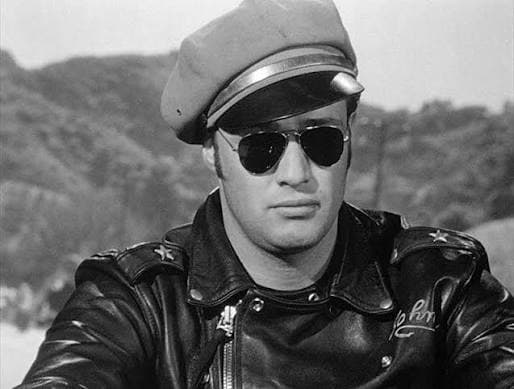
Johnny Strabler in The Wild One helped define this visual grammar. His sunglasses do not simply make him look cool. They make him look sealed off from the world judging him. The town looks at him as a threat, but the glasses keep his inner life just out of reach. He becomes less a person to understand than an image to react to.

That image carries into the later screen rebels. Danny Zuko in Grease uses sunglasses as part of the costume of teenage toughness. The lenses support the act: aloof, charming, slightly untouchable. But the film keeps showing that the act is unstable. Danny wants to appear careless, yet he is deeply concerned with how he is seen. The sunglasses help him perform coolly while protecting him from the embarrassment of wanting too much.

Maverick in Top Gun turns the rebel into something sleeker and more institutional. His aviators are tied to speed, risk, competition, and masculine confidence. They make him look composed even when he is reckless. The glasses do not hide his arrogance; they polish it. They turn danger into style, making disobedience look almost graceful.
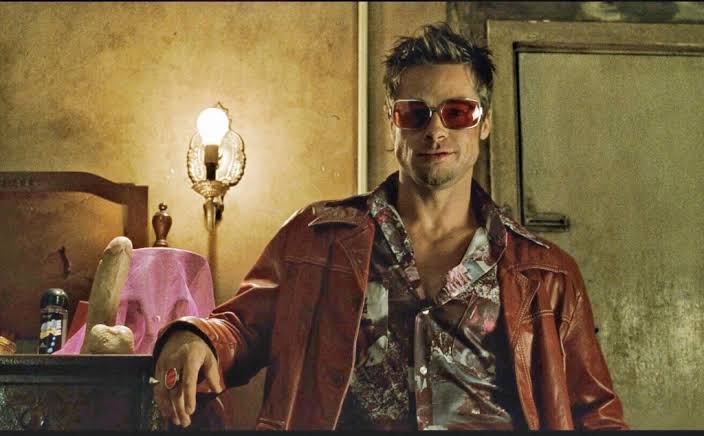
Tyler Durden in Fight Club pushes the rebel image into something more corrosive. His sunglasses are not just about coolness. They help turn him into a fantasy of freedom from shame, work, manners, consumer taste, and ordinary male anxiety. He looks like someone who has escaped the rules because he is, in many ways, made from the desire to escape them. The sunglasses make it harder to question him at first. They give the illusion a face.
Across these characters, sunglasses create distance before they create intimacy.
They let the rebel look at others without being looked at. That is the quiet power of the stereotype. The rebel seems free because he appears unreadable. Other characters have to wonder what sits behind the lenses: pain, arrogance, loneliness, performance, or nothing at all.
The sunglasses do not reveal the rebel. They protect the myth long enough for everyone else to believe in it.
The Star
If the rebel uses sunglasses to resist being read, the star uses them to control access.
On the star, shades become a sign of glamour, status, and distance. They suggest a person accustomed to being watched, but not necessarily known. The face remains visible, yet the eyes are withheld. That small act of concealment changes the power dynamic. Everyone else looks. The star decides how much can be returned.
This is why sunglasses feel so natural on characters surrounded by attention. They create a barrier without removing the character from view. In fact, they often make the character more visible. The covered eyes turn the face into an image, polished and unreachable.
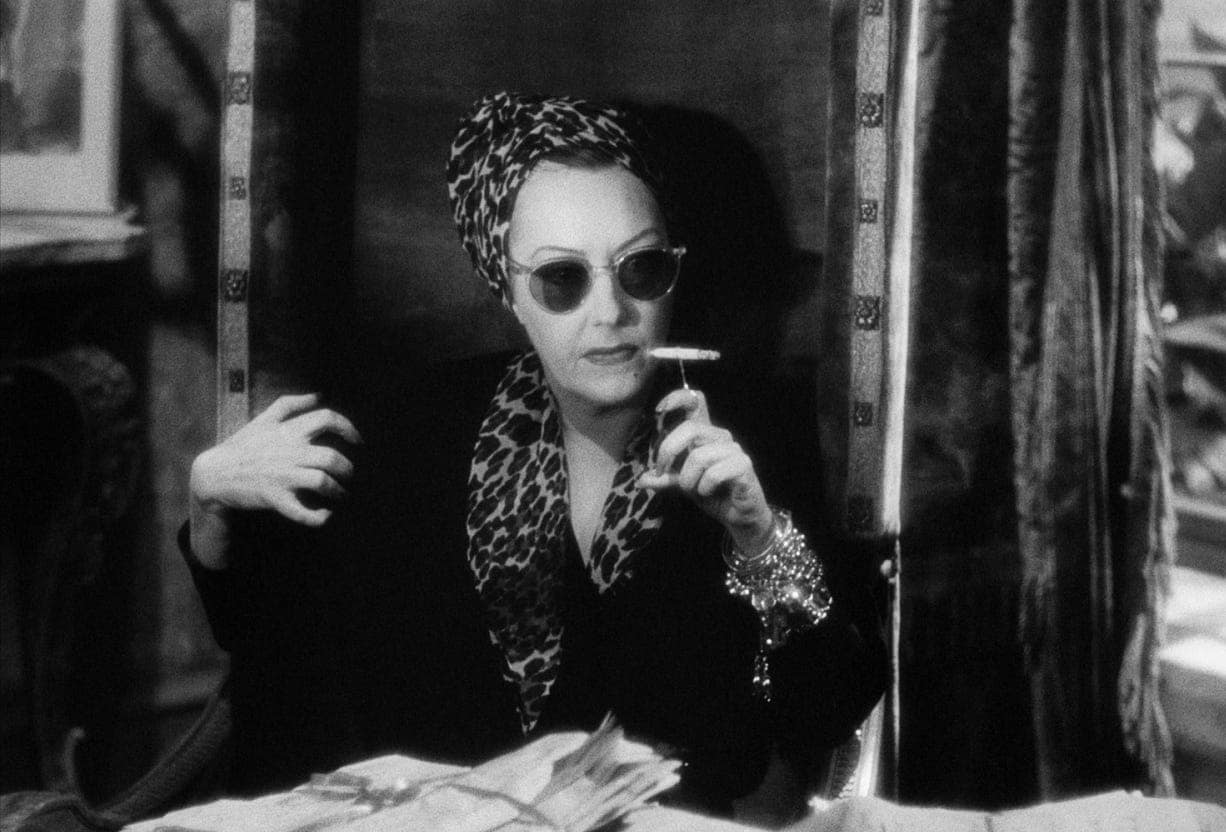
Norma Desmond in Sunset Boulevard belongs to the older, haunted version of this archetype. Her dark glasses carry the residue of stardom, but also its isolation. They protect a woman who has been looked at for so long that being seen has become almost unbearable. The shades do not simply make her glamorous. They make her look preserved, enclosed, trapped inside the memory of her own image.
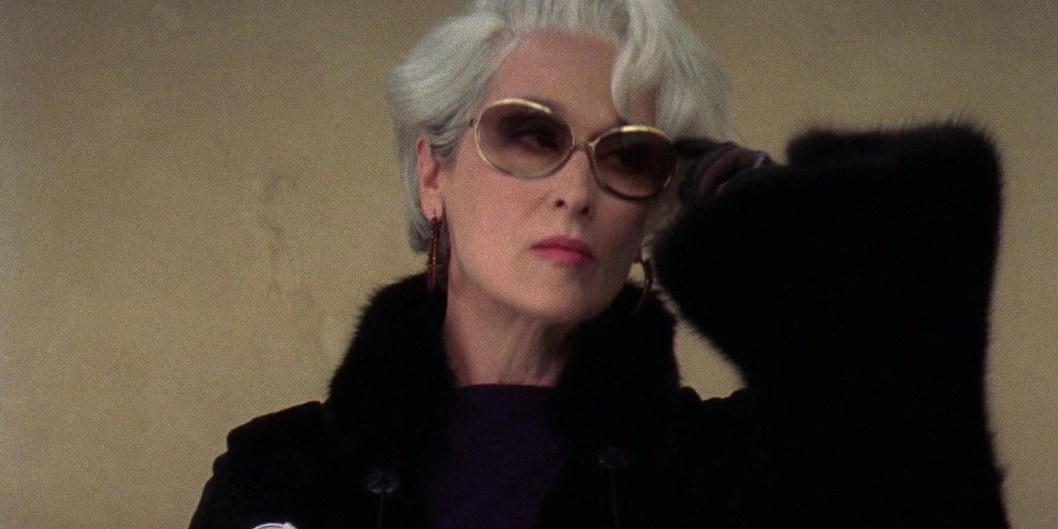
Miranda Priestly in The Devil Wears Prada uses sunglasses differently. Hers are not about fragility. They are about command. When she appears in shades, she seems removed from ordinary social obligation. She does not have to meet people with warmth. She does not have to make herself available. The glasses help turn taste into authority, and authority into distance. She is not hiding because she is weak. She is withholding because she can.
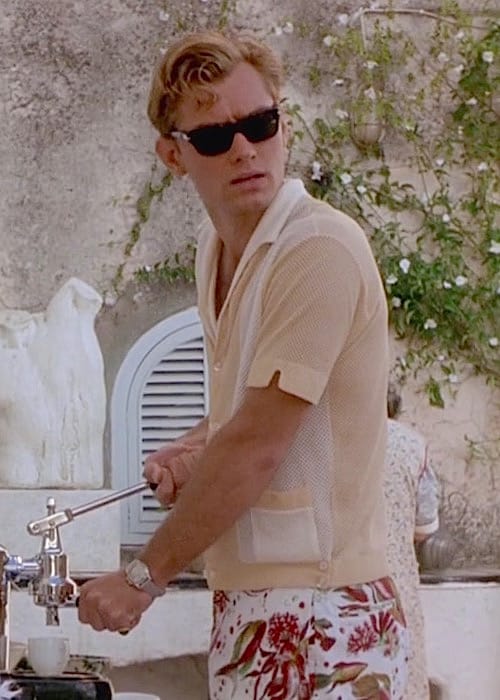
Dickie Greenleaf in The Talented Mr. Ripley shows the same archetype in a more leisurely register. His sunglasses belong to wealth, sun, youth, and ease. They make him look careless in the way only the protected can appear careless. He is beautiful, admired, and socially magnetic, but also difficult to possess. The shades help create that cruelty. They let him remain bright and distant at the same time.
Across these figures, sunglasses turn visibility into status.
The star is not hidden in the ordinary sense. The star is displayed, framed, and protected all at once. The eyes disappear, but the image becomes stronger.
That is the glamour of the archetype.
The shades make the character look available to admiration, but unavailable to possession. Everyone can see them. Not everyone gets to reach them.
The Villain
On the villain, sunglasses do something more severe.
They hide the part of the face where humanity is usually searched for. The eyes are where film lets us look for hesitation, fear, pity, guilt, or recognition. Cover them, and the villain becomes harder to soften. The face remains, but the person behind it feels less available.
This is why shades can make a villain feel cold before they become violent.
The audience cannot easily read the flicker beneath the surface. We cannot tell what the character wants, how much they feel, or whether anything human is interrupting the threat. The glasses flatten emotion. They make cruelty seem cleaner, more controlled, and more difficult to appeal to.
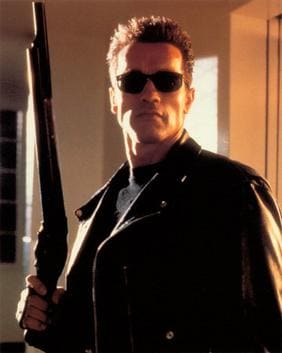
The T-800 in The Terminator is the clearest version of this. His sunglasses do not make him stylish in the usual sense. They erase what little human warmth his face might offer. The dark lenses turn him into a moving machine, a body with no visible doubt. Without the eyes, there is no place for the audience to look for mercy.
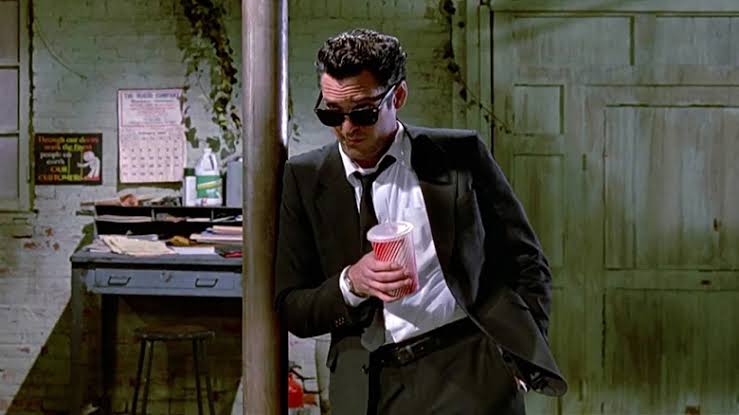
Mr. Blonde in Reservoir Dogs carries a different kind of menace. His sunglasses are casual, almost playful, which makes the violence more disturbing. He does not look frantic or monstrous. He looks relaxed. The shades help create that emotional mismatch: a man capable of cruelty, yet dressed in the language of cool detachment.
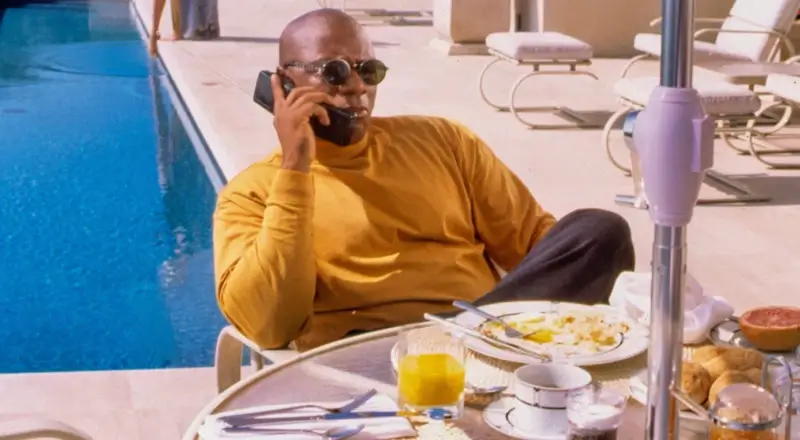
Marsellus Wallace in Pulp Fiction uses sunglasses as a sign of power withheld. He is often framed as someone other characters fear before the audience fully knows him. The shades help preserve that distance. They keep him partially unreadable, turning him into a presence that feels larger than the scene around him.
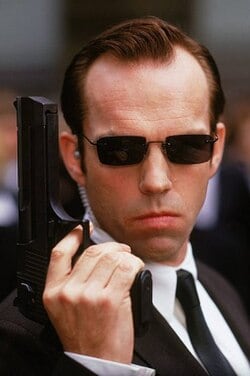
Agent Smith in The Matrix takes the villain’s sunglasses into the realm of systems and control. His dark lenses make him look less like an individual and more like an extension of an order. He watches without revealing himself. He speaks with precision. He moves with the confidence of something that does not need sympathy.
Across these characters, sunglasses remove the small signals that might make violence feel human.
The villain does not need to be understood. They need to be felt as a threat.
That is what the shades create: a face without invitation, a gaze without access, a person whose interior life has been sealed from view. The result is not just a mystery. It is moral distance.
Eyeglasses can make a character seem exposed.
Sunglasses, on the villain, make them feel unreachable.
You Are Your Glasses
By the time a character enters the frame, the audience is already reading.
A pair of eyeglasses appears, and the face begins to gather certain meanings: awkwardness, intellect, discipline, repression, hidden beauty, quiet authority. A pair of sunglasses appears, and the same face moves somewhere else entirely: toward glamour, danger, coolness, distance, secrecy, or status.
The frame does not change the person.
It changes the story that forms around them.
That is why glasses matter so much in film and television. They are small objects with striking narrative weight. They can decide who gets mocked, who gets trusted, who gets underestimated, who gets desired, and who is allowed to hide behind a version of themselves the world finds easier to understand.
Eyeglasses often make a character more readable. They expose the face to interpretation. They invite the audience to look for the mind, the flaw, the insecurity, the secret, the self waiting to be revealed.
Sunglasses move differently. They interrupt that reading. They cover the eyes, limit access, and make the character harder to reach. The rebel becomes cooler because we cannot fully read him. The star becomes more glamorous because she remains slightly withheld. The villain becomes colder because the eyes no longer ask to be humanized.
Together, they create two halves of the filmic language of frames.
One reveals.
One conceals.
One asks the audience to judge too quickly.
The other denies the audience enough information to judge at all.
And yet both remind us of the same thing: in cinema, identity is never built from the face alone. It is built from the signs around it, the objects placed on it, and the assumptions the audience brings into the room.
That is the filmic language of frames.
Not a language of lenses, prescriptions, or fashion alone, but of assumption. The audience sees the frame and starts filling in the character around it.