Last Updated on June 11, 2026 by Hanna Tejada
In the 1970, there is this photograph that encapsulates timeless elegance that still holds today. It happened under the blinding Mexican sun, at a soccer tournament final. A man in a canary yellow jersey leaps into the competitive air after scoring the opening goal. He is grinning and his fist clenched grimace of effort. For the first time, the world watched the tournament in color. That was the first time when it was understood that he has a singular presence among the rest.
The 1970 FIFA World Cup in Mexico was the first to be broadcast globally in saturated color, and the effect was irreversible. Before that summer, the world had consumed international football through grainy black-and-white television, a visual register where the sun-like Brazilian kit read as simply another shade of grey. Color changed everything.
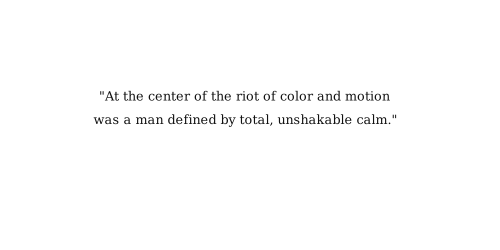
By 1970, Pelé was already a two-time World Cup champion. But color broadcast fused his image with the golden shirt in the global imagination. What is less examined, and equally worth celebrating, is the aesthetic he cultivated once he removed it.
A Decade of Excess

Pelé hoisting the Jules Rimet trophy, the original FIFA World Cup trophy. Courtesy of getbezel/IG
To fully appreciate Pelé’s off-pitch style, you must first understand what it was pushing against. The early 1970s marked a violent, deliberate departure from the conservative tailoring of the previous decade. Where the 1960s favored slim worsted wool suits, narrow ties, and rigid formality, the new decade embraced unabashed flamboyance, wider lapels, exaggerated bellied collars, aggressively flared trousers, and synthetic polyesters beloved by the burgeoning disco scene. The goal of dressing was, explicitly, to be seen.
This cultural shift had a pronounced effect on athletes navigating their own social transformation. As television contracts expanded and endorsements became lucrative, athletes ceased to be local heroes and became pop culture monoliths. Many adopted the wardrobes to match.
Walt “Clyde” Frazier of the New York Knicks arrived at Madison Square Garden in full-length mink coats, commissioning bespoke shoes from ostrich, alligator, and stingray skins. Joe Namath wore a full fur coat on the NFL sidelines. George Best, “the Fifth Beatle”, drove an E-Type Jaguar and donned sharkskin suits, deep polo necks, and hip-hugger pants as a vehicle for self-promotion and cultural survival. These were not trivial choices. Each man was demanding, through sheer visual volume, that the world acknowledge his presence.
Pelé had no such need. And that difference is the whole story.
Pele Mastered The Anatomy of Restraint in the 70s
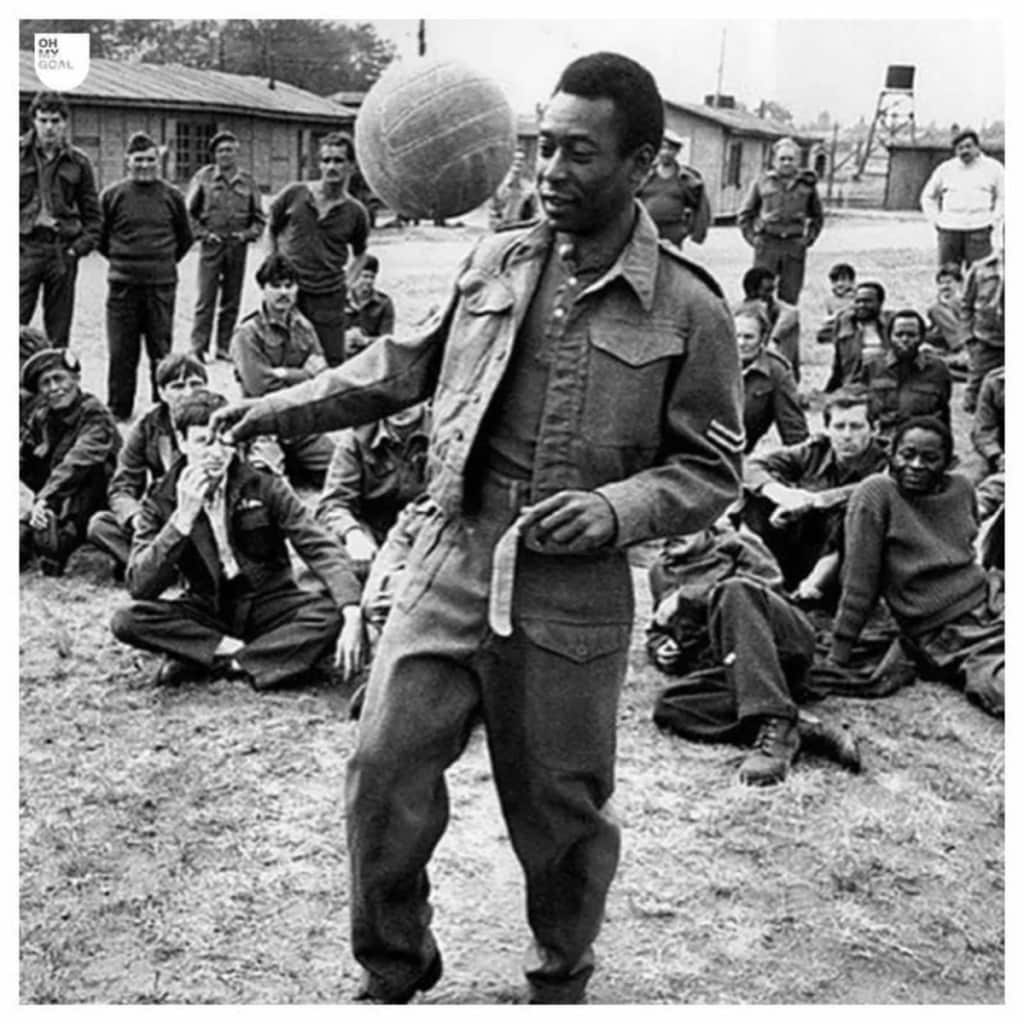
Pelé’s off-pitch wardrobe was a masterclass in sprezzatura, the Italian concept of studied carelessness, the ability to appear effortlessly composed without seeming to have tried at all. He did not ignore the 1970s; he adapted its broader grammar to suit his own needs. But he entirely rejected the decade’s more gaudy, costume-like tendencies.
His approach to tailoring is where this restraint was most legible. He wore three-piece suits with the signature oversized collars of the era, but while fashion dictated exaggerated bellied lapels and flared bell-bottoms, Pelé favored flawless, slim-cut construction that respected his athletic frame without clinging to it. Crucially, he chose refined natural wools, linens, and high-quality cotton blends over shiny synthetic polyesters, ensuring his suiting maintained a structural integrity and dignity that eluded many of his contemporaries.
His relationship with color was equally considered. Against the blinding, iconic yellow of his professional uniform, his off-pitch wardrobe anchored itself in a grounded, mature palette: warm creams, rich tobaccos, deep charcoals, sharp navies. This restraint was not timidity, it was a form of color theory in practice. When he did experiment with the vibrant hues typical of 1970s menswear, he did so with monochromatic precision, executing even a daring red leather ensemble with careful pairing rather than clashing prints.
His mastery of casual elegance was perhaps the most genuinely ahead of its time. His rotation of crisp knit polos, unstructured blazers, and lightweight roll-necks demonstrated an acute understanding of texture and drape. He mastered the precarious art of the 1970s open collar: while the disco era encouraged men to unbutton silk shirts to their navels, Pelé left his wide-collared shirts unbuttoned just enough to project effortless swagger without ever crossing the line into sloppiness, paired with tailored short-shorts and simple, unbranded footwear, proving that athletic casualwear could be elevated to an art form long before the advent of luxury athleisure.
From Santos to Studio 54
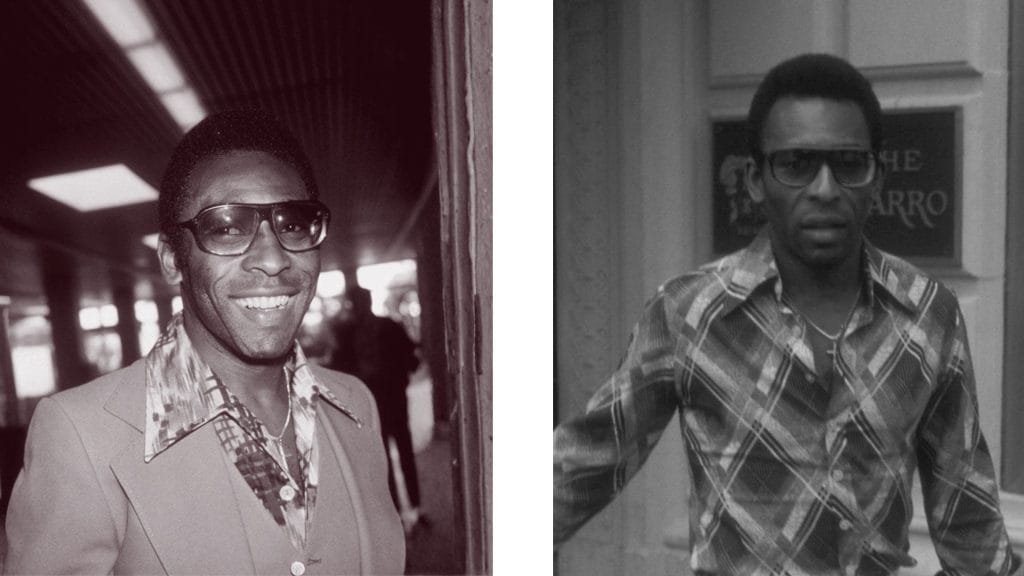
Courtesy of Rex Features and Pinterest
In 1975, after a five-part contract worth an estimated $4.5 million, negotiations so geopolitically significant that U.S. Secretary of State Henry Kissinger personally called his Brazilian counterpart to argue the diplomatic merits, Pelé arrived in New York to join the Cosmos. The kid from Três Corações was suddenly a resident of the most glamorous, chaotic, and media-saturated city in the world.
The move demanded an evolution in his wardrobe. As the Cosmos traveled the globe like rock stars, Pelé introduced tailored tracksuits into his rotation, elegantly fitted Umbro cotton and navy-and-green track jackets, paired with crisp polo shirts and flawlessly hemmed trousers. These garments proved that the comfort required for transcontinental travel didn’t necessitate a sacrifice of shape or dignity, a standard for off-duty athlete fashion that presaged the entire genre of luxury travel wear by several decades.
Nowhere, however, was his aesthetic more fully realized than in his navigation of 1970s New York nightlife. Studio 54, opened in 1977 by Steve Rubell and Ian Schrager, its guest list running from Truman Capote to Yves Saint Laurent, was an intimidating, euphoric environment throbbing to a Donna Summer beat, its atmosphere one of unrestrained, sequin-drenched excess. When Pelé entered this maelstrom, he did not adopt its costumes.
Photographs capture him alongside Steve Rubell in perfectly tailored, understated blazers and open-collared shirts, projecting total self-assurance. He dressed like a man who never needed to prove he belonged in the room, because his presence alone validated the room’s importance.
In 1977, as part of his 10 Portraits of Athletes series, Warhol created Edson-Pelé, acrylic and silkscreen on canvas, vibrant kinetic colors reverberating around the subject’s head as if simulating the energy released on contact with a football. The portrait stands as the ultimate testament: Pelé had conquered the pinnacle of global sport, and through refined personal style and quiet charisma, he had effortlessly conquered the epicenter of global pop culture.
The Timelessness of Quiet Swagger
Today’s elite footballers navigate their pre-match arrivals as highly scrutinized “tunnel walks” that mimic the runways of Paris and Milan, a world of heavily branded luxury streetwear, avant-garde silhouettes, and logo-centric choices where the price tag frequently takes precedence over the intrinsic harmony of the design. These are genuine expressions of identity, and culturally significant ones. But they are driven, at their core, by a need to capture the spotlight.
Modern athletes dress to capture the spotlight. Pelé dressed because he already was the spotlight.
The enduring lesson of his 1970s Golden Aesthetic is one of the simplest and most difficult propositions in the history of personal style: true elegance is entirely about the man wearing the clothes, not the clothes wearing the man. In an era where his sporting peers were wrapping themselves in mink coats, platform shoes, and synthetic excess to announce their success to the world, Pelé relied on the quiet power of exceptional tailoring, flawless fit, and a grounded color palette.