Last Updated on February 24, 2026 by Faulton Cinco
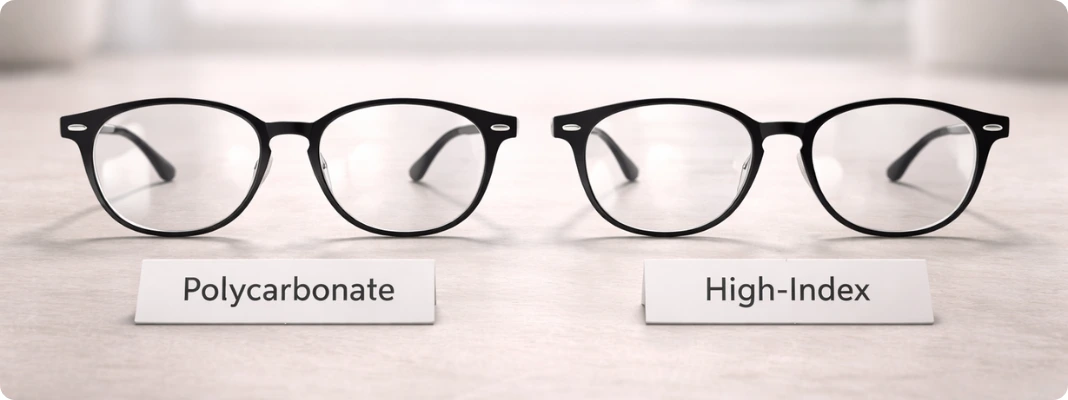
Ever wonder why two people can have the same prescription, but one pair of glasses looks sleek while the other looks thick and heavy? That usually comes down to lens material, and it is exactly why the difference between polycarbonate and high-index matters when you are choosing your next pair.
In this guide to understanding your lenses, you will learn what polycarbonate and high-index lenses actually are, how lens index affects thickness and comfort, and which option makes the most sense for your prescription, lifestyle, and budget. We will also compare pros and cons side by side, explain when 1.67 or 1.74 high-index is worth it, and share simple tips like frame choices and coatings that can make any lenses look better.
Polycarbonate vs High-Index In 30 Seconds
Need the quick answer before you compare pros and cons? Use this fast guide to pick the lens material that best matches your prescription strength, lifestyle, and how thin you want your lenses to look.
Choose polycarbonate if:
- You want impact resistant lenses for everyday durability (great for kids, sports, and clumsy moments).
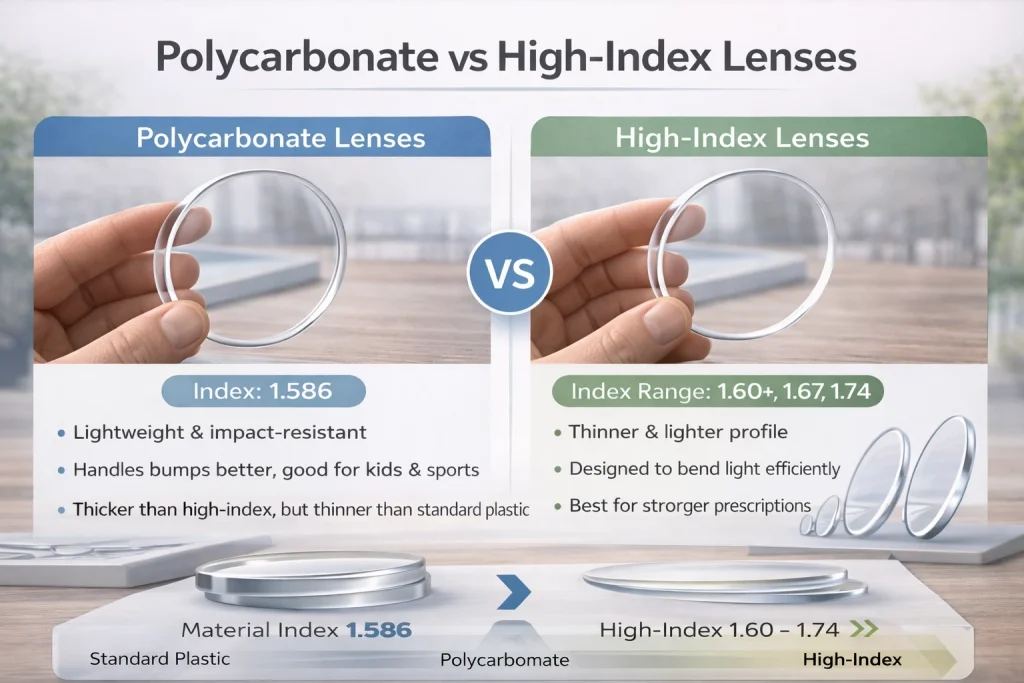
- You want a lens that is naturally thinner than standard plastic because it has a higher lens index (about 1.586).
- You want a lightweight, practical option that usually costs less than high-index.
Choose high-index if:
- Your prescription is strong and you care most about reducing lens thickness (especially at the edges). High-index starts around 1.60 and goes up to 1.74.
- You want the thinnest look possible with common options like 1.67 lenses and 1.74 lenses (1.74 is typically thinner than 1.67).
- You wear larger frames and want to avoid the “thick lens” look as much as possible.
Tip: If glare is one of your biggest complaints, adding an anti-reflective coating can matter as much as the material, especially on thinner, higher-index lenses.
What “Index” Means and Why It Changes Lens Thickness
Lens materials are not all the same, and the “index” number is one of the quickest ways to understand why some lenses look thinner than others. Once you know what lens index means, it becomes much easier to choose between polycarbonate and high-index based on your prescription and the frame you want.

What “Lens Index” Actually Means
Lens index (refractive index) is a number that describes how efficiently a lens material bends light. The higher the index, the less lens material you typically need to create the same prescription power. That is why higher index materials are often associated with thin lenses.
Why Index Changes Thickness
A higher index can make lenses thinner, but it does not automatically mean “better” for everyone. If your prescription is mild, the thickness difference can be small, and durability or comfort might matter more than shaving off a little edge thickness.
Here is the simple takeaway:
- Higher indexes can reduce thickness for the same prescription.
- The stronger the prescription, the more you notice the difference.
- The frame you choose can amplify or reduce that difference.
Still not sure what “high-index” actually means on a lens order? This quick explainer on what high-index lenses are makes the term easy to decode.
Mini “Lens Thickness Chart”
These are common index ranges you will see when comparing eyeglass lens materials:
| Lens Material | Typical Index | What It Means |
|---|---|---|
| Standard plastic (CR-39) | ~1.50 | Thicker than specialty materials for the same Rx |
| Trivex lenses | ~1.53 | Strong and clear, often chosen for durability and optics |
| Polycarbonate lenses | ~1.586 | Thinner than standard plastic, very impact-resistant |
| High-index | 1.60 to 1.74 | Thinner for stronger prescriptions, 1.74 is among the thinnest common options |
One helpful benchmark: a 1.74 index lens can be up to about 50% thinner than a standard 1.50 plastic lens for the same prescription, depending on the Rx and frame.
What Else Affects Thickness
Even with the same material, two people with the same prescription can end up with different-looking lenses because of:
Frame Size
Bigger frames usually mean more lens thickness, especially if you are nearsighted, because the lens edges have to cover a wider area. If you want thin lenses without jumping straight to the highest lens index, choosing a slightly smaller frame can make both polycarbonate lenses and high-index lenses look noticeably slimmer.
Frame Shape
Wide rectangles tend to show thicker edges more than round or oval frames, even with the same prescription lenses. For a cleaner look in a stronger Rx, rounder shapes often pair better with high-index lenses because the edge thickness is spread more evenly around the frame.
Prescription Details
Your Sphere, Cylinder, and Axis values affect how the lens is engineered, which is why two people can choose the same material and still end up with different-looking lenses. If your prescription includes higher astigmatism correction, the lens may need extra shaping, so high index lenses can be helpful when you are trying to reduce bulk.
Pupillary Distance and Lens Centering
Your pupillary distance (PD) and how the lenses are centered determine where thickness shows up and how comfortable your vision feels. Even the best eyeglass lens materials can look thicker or feel “off” if the optical center is not aligned, so accurate PD is key when ordering polycarbonate vs high index lenses online.
If you remember one thing from this section: index matters, but it is only one part of what makes lenses look and feel “thin.”
If you want your lenses to look thinner and sit correctly in the frame, it helps to understand pupillary distance and why it matters before you place an order.
What Are Polycarbonate Lenses?
Polycarbonate lenses are a tough, lightweight plastic lens material that became popular because it handles everyday bumps better than standard plastic. If you have an active lifestyle or you are buying glasses for kids, polycarbonate is often the first material an optician will mention.

Polycarbonate has a lens index around 1.586, which means it can be a bit thinner than basic 1.50 plastic, but it is not as thin as most high-index lenses
Why People Choose Polycarbonate
Polycarbonate is a popular choice because it balances comfort, durability, and everyday practicality. It is especially appealing if you want impact resistant lenses that still feel lightweight.
Impact Resistance
Polycarbonate lenses are highly impact resistant, which makes them a smart pick for kids, sports, and active routines. They handle everyday bumps better than many other eyeglass lens materials.
Lightweight Feel
Polycarbonate is known for being among the more lightweight lenses, so it tends to feel comfortable for all-day wear. This can be helpful if your glasses feel heavy or leave pressure marks.
Ultraviolet Protection
Polycarbonate lenses typically provide built-in ultraviolet protection, helping shield your eyes during daily outdoor exposure. It is still worth confirming the UV rating on your order so you know exactly what is included.
Trade-Offs to Know Before You Choose It
Polycarbonate can be slightly less crisp for some wearers because it has a lower Abbe value, which may show as mild color fringing or edge distortion in certain prescriptions. It can also scratch more easily than some other lens materials, so a scratch-resistant coating is a smart add-on. If you are very sensitive to clarity, Trivex can be a good alternative that stays impact resistant while often offering sharper optics.
Polycarbonate At A Glance
| What You Care | What Polycarbonate Does | What To Watch For |
|---|---|---|
| Durability | Excellent for impact resistant lenses | Add scratch-resistant coating |
| Thickness | Thinner than basic plastic (1.50) | Not the thinnest for strong prescriptions |
| Clarity | Fine for many people | More chance of color fringing for sensitive wearers |
| Ultraviolet protection | Typically built-in | Still confirm specs if you are comparing products |
Best Fit For: kids’ glasses, sports glasses, safety-focused wear, and anyone prioritizing durability over “absolute crispest” optics.
If you are weighing durability versus clarity, check out polycarbonate prescription lenses pros and cons to see what polycarbonate does best and where it can fall short.
What Are High-index Lenses?
High-index lenses are designed for one main goal: thin lenses. They bend light more efficiently than standard plastic, so you can get a slimmer profile with the same prescription.
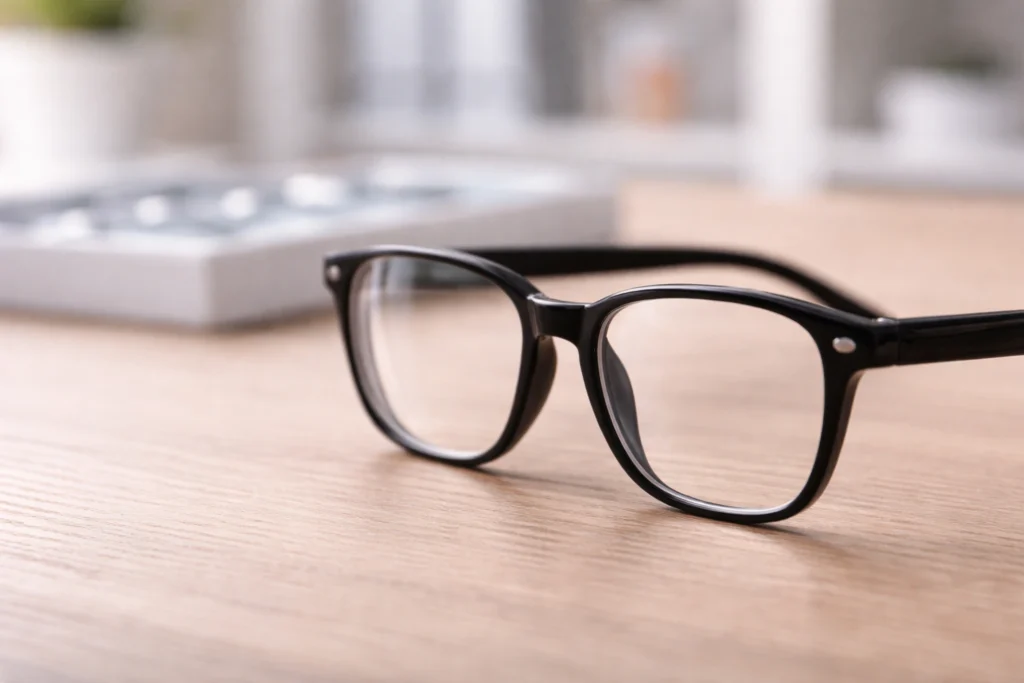
Standard plastic is usually around 1.50. High-index materials are anything above that, commonly 1.60, 1.67 lenses, and 1.74 lenses. In general, the higher the index, the thinner the Lens For The Same Prescription.
Why People Choose High-Index
High-index lenses are chosen mainly for one reason: they can make prescription lenses look slimmer and feel more comfortable when your Rx is strong.
Thinner Edges for Strong Prescriptions
High-index lenses are designed to reduce lens thickness, so edges look noticeably thinner in stronger prescriptions, especially for nearsighted (minus) prescriptions. This is why they are often considered the best lenses for high prescription wearers.
Less “Bottle Lens” Look
Because the lenses are thinner, high-index options can reduce the “bulky” look and help glasses look more balanced in many frame shapes. This is a big reason people compare high-index vs polycarbonate lenses when they care about appearance.
Flatter, Cleaner-Looking Lens Designs
High-index materials are often paired with modern lens designs like aspheric lenses, which can keep lenses flatter and reduce the “bug-eye” or magnified look in some prescriptions. If thin, clean-looking lenses are your priority, 1.67 lenses or 1.74 lenses are common upgrade paths depending on prescription strength.
The Trade-Offs
High-index lenses are “better at being thin,” but they can reflect more light, which is why an anti-reflective coating is especially helpful. Some high-index materials may also have lower Abbe values, which can increase color fringing for sensitive wearers. Cost is the other trade-off, since you are paying more for thinner lens performance.
High-Index At A Glance
| What You Care | High-Index Helps With | What To Watch For |
|---|---|---|
| Lens thickness | Best for best lenses for high prescription | Higher index usually costs more |
| Appearance | Cleaner edges, less bulky profile | Reflections increase, get anti-reflective coating |
| Clarity comfort | Often good, but varies by wearer | Abbe value drops as index rises for many materials |
| Ultraviolet protection | Many high-index plastics block 100% ultraviolet | Confirm material specs if you are comparing options |
Polycarbonate Vs High-Index: Head-To-Head Comparison
If you are stuck on polycarbonate vs high index, do not start with the marketing words. Start with what you want your glasses to do every day: stay durable, feel lighter, look thinner, or cut glare.
The chart below translates the differences into practical outcomes.
| Decision Factor | Polycarbonate Lenses | High-index Lenses |
|---|---|---|
| Best for | Durability and everyday knocks | Thinness for stronger prescriptions |
| Lens thickness | Thinner than standard plastic, but not the thinnest | Often the thinnest option for a strong Rx |
| Weight | Lightweight lenses in most prescriptions | Often lighter than standard plastic for strong prescriptions |
| Impact resistance | Strong advantage, often chosen for active wear and kids | Varies by material, usually not chosen mainly for impact resistance |
| Optical clarity | Good for many people, but some notice more edge distortion or color fringing | Often good, but higher index can also reduce Abbe value, so comfort varies |
| Glare and reflections | Can still reflect light, but often less talked about | More likely to reflect light, so anti-reflective coating matters more |
| Scratch resistance | Needs a scratch-resistant coating for best long-term durability | Also benefits from coatings, especially if you want a cleaner surface |
| Cost | Usually more budget-friendly | Higher cost, and price tends to rise as index increases (1.60, 1.67 lenses, 1.74 lenses) |
| Ultraviolet protection | Polycarbonate typically blocks 100% ultraviolet | Many high-index plastics also block 100% ultraviolet, but confirm material specs |
Reality Check: Most people do not choose high-index because it is “better” overall. They choose it because it is better at reducing lens thickness when a prescription is strong enough that thickness becomes noticeable.
If glare is a dealbreaker for you, this breakdown of everything you need to know about lens coatings can help you pick the right add-ons for clearer vision.
What Matters Most for “Thin Lenses”
If you want thin lenses, your lens material matters, but these details can make just as big of a difference in how thick your prescription lenses look.
Frame Size
Bigger frames usually increase lens thickness, especially for nearsighted prescriptions, because the lens has to cover a wider area. If you want a slimmer look with either polycarbonate lenses or high-index lenses, choosing a slightly smaller frame is one of the simplest upgrades.
Frame Shape
Round or oval frames can help reduce visible edge thickness compared with wide rectangles because thickness is distributed more evenly around the lens. This is especially helpful when you are comparing polycarbonate vs high index and trying to decide if you truly need a higher lens index.
Lens Design and Centering
How the lenses are designed and centered to your pupillary distance affects where thickness shows and how natural your vision feels. Even high-index lenses can look thicker or feel off if the optical center is not aligned, so accurate measurements matter.
If you want thin lenses without jumping to the most expensive option, a smaller frame is often the easiest win.
Where Polycarbonate Wins
Polycarbonate is the easiest “yes” when you want:
- Impact resistant lenses for daily life, sports, or kids.
- A lightweight feel without paying more for thinness you may not need.
- A simple, durable starting point for prescription lenses.
Where High-Index Wins
High-index is usually the better call when:
- Your prescription is strong enough that you see lens thickness from the front or side.
- You want a cleaner, less bulky look in larger or more angular frames.
- You are choosing between 1.67 vs 1.74 lenses and your main goal is maximum thinness.
Quick Tip: If you pick high-index, consider anti-reflective coating as part of the same decision, not an optional add-on. It can improve comfort, night driving clarity, and the “invisible lens” look.
Polycarbonate Vs. High-Index: Which Lens Is Right For You?
Use this as a practical shortcut. It is not a diagnosis, but it will get most shoppers to the right lane fast.
Step 1: Start with your lifestyle
If durability is your priority, polycarbonate lenses are usually the better match because they are made to handle everyday bumps and active routines. They are also a practical choice if you are buying glasses for kids, play sports, commute often, or simply want lightweight lenses at a reasonable budget.
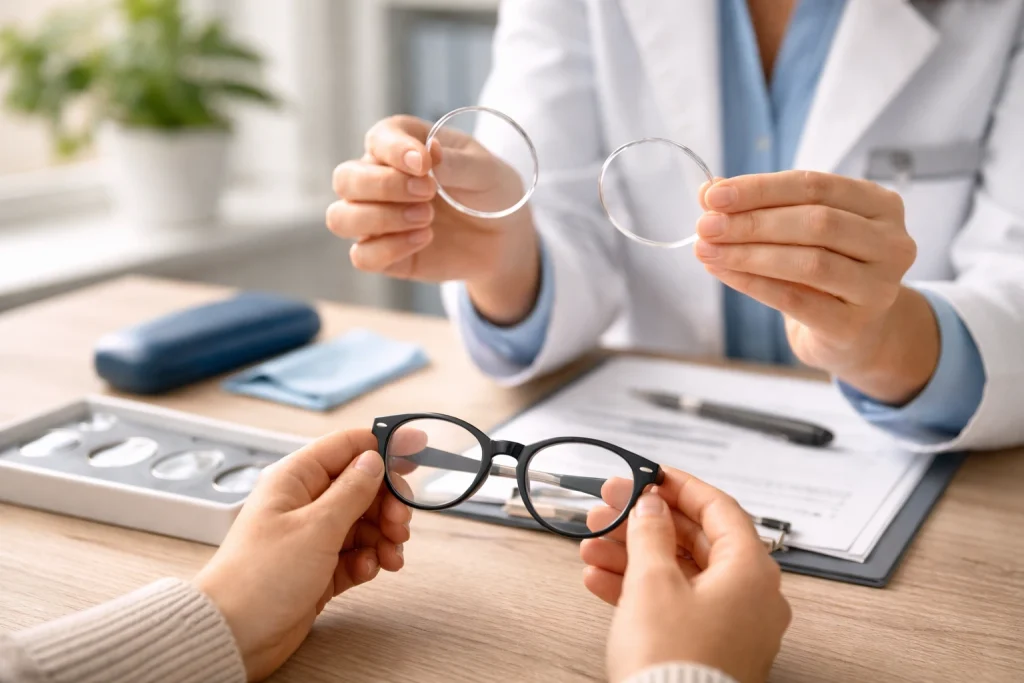
If your main goal is reducing lens thickness, high-index lenses are typically the better fit, especially when your prescription is strong and bulky edges bother you. High-index also makes sense if you love larger frames but want your prescription lenses to look cleaner and more balanced, even if it costs more.
Step 2: Match it to prescription strength
A simple rule many wearers use when comparing polycarbonate vs high index is that mild prescriptions often look fine in polycarbonate, while moderate prescriptions start to show a visible thickness difference with high-index. If your prescription is strong, high index lenses can be worth it for comfort and appearance, and options like 1.67 lenses or 1.74 lenses are common upgrades depending on how much thinness you need.

Not sure how to read the numbers on your Rx before choosing a lens material? Here is a simple guide on how to read your glasses prescription.
Step 3: Decide what you want to optimize
Choose polycarbonate when durability and everyday practicality matter most, especially if you are hard on glasses or want lightweight lenses at a more budget-friendly price. Choose high-index lenses when your top priority is reducing lens thickness, since a higher lens index is designed to create thin lenses for stronger prescriptions.

Comfort is a separate goal worth calling out. For screens and night driving, an anti-reflective coating can make a noticeable difference in clarity and glare control whether you choose polycarbonate or high-index.
Quick “Choose This If” Checklist
- Choose polycarbonate lenses for kids or active wear when impact resistance is your top concern.
- Choose high-index lenses for strong prescription when thickness and appearance are the biggest issues.
- If you are deciding between 1.67 vs 1.74 lenses, 1.74 is usually the thinner option, but it is often more expensive, so it is most useful when your prescription is very strong or your frame is large.
Polycarbonate Vs. High-index: Comparison That Helps You Decide
Both polycarbonate lenses and high-index lenses are lightweight plastics used for modern prescription eyewear. The difference comes down to what you prioritize most: impact resistance (polycarbonate) versus thinner edges for stronger prescriptions (high-index).
| What You Care | Polycarbonate | High-Index (1.60, 1.67, 1.74) |
|---|---|---|
| Lens index and thickness | Index is about 1.58 to 1.59, so thickness is “middle of the road” | Higher index (1.60 to 1.74) usually means thinner lenses, especially for stronger prescriptions |
| Weight and feel | Light, and often a good everyday choice | Can be thinner, but some high-index materials are denser, so thinner does not always mean lighter |
| Impact resistance | Very impact resistant, commonly chosen for kids and active wear | Varies by material and thickness, not usually the first pick when impact resistance is your top concern |
| Optical clarity | Lower Abbe value can mean more color fringing for some people | Many high-index options have better Abbe than polycarbonate, but it depends on the specific index and material |
| Reflections and glare | Reflects some light, like all lenses | Higher index tends to reflect more light, so an anti-reflective coating matters more |
| Ultraviolet (UV) protection | Commonly blocks ultraviolet (UV) very well | Many high-index plastics also block ultraviolet (UV), but it is still smart to confirm what is included |
| Cost | Usually more budget friendly | Typically costs more than polycarbonate |
A note on Trivex lenses (helpful third option): If you want impact resistance closer to polycarbonate but with clearer optics (higher Abbe), Trivex lenses are often a great middle ground.
Which Lens Is Right For You?
Use this like a fast filter. You do not need to overthink it.
Choose polycarbonate if you want:
- Impact resistant lenses for daily life, active wear, or kids’ glasses
- A lightweight, practical option for mild to moderate prescriptions
- A value-friendly lens material that still performs well
Choose high-index lenses if you want:
- Thin lenses because your prescription is strong and you dislike thick edges
- A cleaner cosmetic look in larger frames or higher minus prescriptions
- Better comfort from reduced “front-heavy” feel in some strong prescriptions
Many retailers recommend 1.67 lenses once you are around total power of plus or minus 4.00 or higher, and 1.74 lenses as prescriptions climb further.
Consider Trivex if:
- You want a tough lens for everyday wear but are sensitive to polycarbonate’s optical trade-offs.
If you are unsure, the safest route is: ask your eye care professional what lens material they recommend for your exact prescription, frame choice, and lifestyle.
How To Make Any Lens Look Better
Your frame can make the “same prescription lenses” look thinner and feel more comfortable.
Quick Wins That Reduce Lens Thickness and Improve The Look
- Go a little smaller. Less lens area usually means thinner edges for minus prescriptions.
- Pick rounder shapes when possible. Corners in big rectangles tend to show thickness more.
- Choose a full-rim frame. It hides lens edges better than semi-rimless styles.
- If you are getting high-index lenses, avoid oversized frames unless you truly love the look.
- Ask for anti-reflective coating if you notice glare, especially in higher index materials.
Simple Rule: if you want a thinner look, do not fight physics with an oversized frame.
If you want lenses to look slimmer on your face, start with a flattering frame shape using this guide on how to choose the right glasses for your face shape.
Top 5 Frames That Pair Well With Polycarbonate or High-Index Lenses
Below are five frames where the shape and sizing can help you get better looking lenses. In general, smaller lens widths and well centered pupils help reduce edge thickness, especially if you go with high index lenses.
1. Whitney Low Bridge Fit (Brandy Tortoise)
A smaller, face balancing square is a great match if you want thin lenses without sacrificing everyday style. Whitney lists polycarbonate lenses and 1.67 high index as lens material options, plus anti reflective and scratch resistant coatings.

Best For: medium to strong prescriptions, low bridge fit, daily wear.
Do This: Choose a 1.67 high index if lens thickness is your biggest concern.
Pick Whitney Low Bridge Fit (Brandy Tortoise) if you want a smaller square that helps thin lenses look more balanced, especially with stronger prescriptions. It is a great choice when you want low bridge fit comfort and a clean everyday shape in one frame.
2. Wayward (Goldmine)
A rectangle can look clean and modern, and it often works well for people who want a more structured look. Wayward also lists polycarbonate and 1.67 high index lens material options.

Best For: a sharper silhouette and a “less lens, more frame” look in photos.
Do This: Add anti reflective coating if you do a lot of screens or night driving.
Go for Wayward (Goldmine) if you love a modern rectangle and want a “less lens, more frame” look that photographs well. It is a strong option when you want a structured silhouette and plan to add anti-reflective coating for screens or night driving.
3. Duke Low Bridge Fit (Carbon Black)
Duke Low Bridge Fit is a steady, everyday square that is designed to sit more securely on faces with a lower nose bridge, helping the frame stay centered instead of sliding down. A stable, centered fit can make polycarbonate or 1.67 high-index lenses look cleaner because you are consistently looking through the optical center of the lens. This is a smart pick if you want a classic shape but care a lot about comfort and how your lenses sit on your face.

Best For: low bridge fit needs, everyday wear, medium to stronger prescriptions that benefit from a centered lens position.
Do This: Choose a fit that sits level and does not slide, since stable positioning helps thickness look more even.
Choose Duke Low Bridge Fit (Carbon Black) if you need a low bridge frame that stays put and keeps your lenses centered for clearer, more comfortable vision. It is ideal when you want a classic square style with a more secure fit that supports cleaner-looking lenses.
4. Beaumont (Carbon Black)
Round frames are famously forgiving for stronger prescriptions because they keep lens edges more even. Beaumont is an extra small fit and lists polycarbonate and 1.67 high index as options.
Best For: prescription sunglasses with a cleaner, thinner lens look.
Do This: If your prescription is high, consider a high index for a slimmer sun lens profile.
Reach for Beaumont (Carbon Black) if you want a smaller, round prescription sun frame that helps reduce the look of edge thickness. It is an easy win for higher prescriptions because the round shape keeps the lens profile looking more even.
5. Dakota (Crystal)
Cat eye frames can visually lift the face, and they also hide lens edges well because the frame has more presence. Dakota lists polycarbonate and 1.67 high index lens material options.

Best For: style forward prescription sunglasses that still feel practical.
Do This: Prioritize fit at the bridge so the lenses sit centered and look better.
Select Dakota (Crystal) if you want a cat-eye shape that adds lift and also hides lens edges well. It is a great pick when you want style-forward prescription sunglasses that still feel practical and wearable.
Pick The Lens That Fits You
Choosing between polycarbonate lenses and high-index lenses is really about priorities. If you want everyday durability and impact resistant lenses, polycarbonate is usually the smartest, simplest choice, especially for kids and active routines. If you are focused on thin lenses and a cleaner look with a stronger prescription, high-index is designed for that job, with common options like 1.67 lenses and 1.74 lenses helping reduce lens thickness as prescriptions get stronger.
Use this quick checklist to lock in your decision:
- Pick polycarbonate if you value durability, lighter everyday wear, and budget-friendly performance.
- Pick high-index if your prescription is strong and you want slimmer edges and a more polished look.
- No matter what you choose, frame size and coatings can make a big difference in comfort and clarity, especially anti-reflective coating if you notice glare.
Start with your most recent eye prescription and decide what matters most, durability or lens thinness. Then choose a frame size that flatters your face and supports your lens goals, and select polycarbonate or high-index based on how you actually live, not just what sounds “premium.”
When you are ready, find your next pair in our eyewear collection and select the lens material and coatings that match your prescription and daily routine.
FAQS about Polycarbonate and High-Index Lenses
1. Are polycarbonate lenses good for strong prescriptions?
Yes, polycarbonate can work for strong prescriptions, especially if you prioritize durability and impact resistance. However, once you are around plus or minus 4.00 diopters or higher, many people see a more noticeable thickness improvement with high-index lenses like 1.67. Warby Parker notes that 1.67 can be about 20% thinner than polycarbonate, which is why it is often recommended for stronger prescriptions.
2. What does “high index” mean, and when do I need it?
High-index means the lens material bends light more efficiently, so the lens can be made thinner for the same prescription power. Many eyewear guides recommend considering 1.67 around plus or minus 4.00 to 8.00 diopters and 1.74 for very strong prescriptions around plus or minus 8.00 and up. Your eye care professional can confirm the best index for your exact prescription and frame size.
3. Which is clearer, polycarbonate or high index?
Both can provide sharp vision, but some wearers notice differences in edge clarity depending on the material. Polycarbonate typically has a lower Abbe value than many high-index plastics, which can increase color fringing for people who are sensitive to it. If you are very clarity-sensitive, ask your optician about Trivex or specific high-index materials that balance thinness and visual comfort.
4. Do polycarbonate and high index lenses block ultraviolet (UV) light?
Polycarbonate is commonly described as providing built-in 100% ultraviolet protection, and many high-index plastics also block ultraviolet, depending on the exact formulation. Because ultraviolet protection can vary by lens type and brand, it is still best practice to confirm the ultraviolet rating on your lens order. If your lenses are for everyday outdoor wear, choose lenses clearly labeled to block UVA and UVB.
5. Do high index lenses need anti-reflective coating?
Anti-reflective coating is strongly recommended for high-index lenses because higher-index materials can reflect more light. This coating can reduce glare, improve cosmetic appearance in photos, and make night driving and screen use feel more comfortable. If you notice halos or distracting reflections, anti-reflective coating is one of the highest-impact upgrades you can add.
6. Is Trivex better than polycarbonate?
Trivex and polycarbonate are both impact-resistant, but Trivex is often praised for sharper optics and a higher Abbe value than polycarbonate. The tradeoff is that Trivex may not be available from every retailer and can be thicker than high-index options for strong prescriptions. If you want durability with better optical comfort, Trivex is worth asking your eye care professional about.
7. Can you get high index lenses in prescription sunglasses?
Yes, many retailers offer high-index materials for prescription sunglasses, especially when you want thinner sun lenses in a stronger prescription. High-index can be particularly helpful in larger sunglass frames where thickness is more noticeable. Confirm lens options with your eye doctor or optician so your prescription, tint, and coatings are all compatible.
Disclaimer: This information is for general informational purposes only and is not a substitute for professional advice, diagnosis, or treatment.
References
Summary guide on quality standards for spectacles. World Health Organization. https://www.who.int/publications/i/item/9789240109483. Date Accessed February 17, 2026.
Clinical Policy – Specialty Spectacle Lenses (Policy Number 1330.00). Versant Health (Superior Vision Benefit Management). https://superiorvision.com/wp-content/uploads/2023/05/Clinical-Policy-1330-Specialty-Spectacle-Lenses-effective-8.2023.pdf. Date Accessed February 17, 2026.
Lens Materials and Coatings: The Basics. OpticalTraining.com. https://opticaltraining.com/blog/lens-materials-coatings/. Date Accessed February 17, 2026.
Types of Lenses for Glasses: Which One Is Right for You? Warby Parker. https://www.warbyparker.com/learn/types-of-lenses-for-glasses. Date Accessed February 17, 2026.
Sports Eye Safety Month: Protect Your Eyes in Style! Prevent Blindness. https://preventblindness.org/sports-eye-safety-month-protect-your-eyes-in-style/. Date Accessed February 17, 2026.
Spectacle Lens Materials and their Special Coatings at a Glance. Manika Manika and Meenakshi Wadhwani (Acta Scientific Ophthalmology). https://actascientific.com/ASOP/pdf/ASOP-04-0241.pdf. Date Accessed February 17, 2026.
Chromatic Performance of High Index Plastic Optical Materials. Aristeidis Chandrinos (Journal of Materials Science Research and Reviews). https://journaljmsrr.com/index.php/JMSRR/article/view/165. Date Accessed February 17, 2026.
Meta-Analysis of Materials and Treatments Used in Ophthalmic Lenses: Current Trends in Technologies and Future Directions. Martínez-Pérez, A. M., et al. (National Center for Biotechnology Information (NCBI), PubMed Central (PMC)). https://pmc.ncbi.nlm.nih.gov/articles/PMC11654482/. Date Accessed February 17, 2026.