
Last Updated on March 19, 2026 by Hanna Tejada
Every year, the Academy Awards remind us that fashion lives in the details. Nothing punctuates a red carpet look quite like a pair of exceptional frames. While the conversation usually centers on gowns and tuxedos, the most discerning dressers know that eyewear is the final word in personal style. It signals taste, intention, and confidence all at once.
This year’s ceremony was a quiet masterclass in how to wear glasses on Hollywood’s biggest stage. From black acetate to tinted lenses that pushed the limits of formal dressing, the 2026 Oscars confirmed that frames are no longer an afterthought. Here are the five looks worth studying, and what you can take away from each one.
Michael B. Jordan
Michael B. Jordan saved some of his best styling for the Vanity Fair Oscar Party, where his overall look generated as much conversation as his win. The centerpiece? A pair of rimless sunglasses with custom light amber-tinted lenses from Oliver Peoples.
The choice is precise. Jordan has an oval face, the most versatile face shape in eyewear, with well-balanced proportions and naturally soft features. The angular cut of the rimless frame introduces a sharp horizontal line across his face, creating structural contrast to his bone structure’s natural softness. This is a technique worth noting: when your proportions already work in your favor, heavy frames are unnecessary. You can afford to experiment.
The warm amber tint is the other masterstroke. Lightly tinted lenses, particularly in earth tones, sit at the intersection of optical and sunglass styling. Formal enough for the occasion, expressive enough to read as a deliberate fashion choice.
Style Takeaway: When your proportions are strong, a minimal, well-crafted frame speaks louder than anything oversized. Play with tinted lenses to add personality without losing polish.
Amy Madigan
Best Supporting Actress winner Amy Madigan has made a habit of wearing frames that go beyond the expected,and her Garrett Leight Clune glasses are a perfect example of that confidence in action. The silhouette is round, executed in black acetate, with custom electric yellow lenses.
For a heart-shaped face like Madigan’s, wider at the temples, narrowing toward the chin, round frames are the textbook prescription, and for good reason. The circular curvature of the lenses echoes the natural curve of the chin, which creates a sense of balance between the upper and lower face. The slightly “chunky” acetate construction is equally considered: it adds visual weight to the midface, preventing the look from feeling top-heavy. This is the kind of detail that separates well-fitted eyewear from frames that simply sit on a face.
The yellow lenses, however, are what elevate this from “optically correct” to genuinely memorable. High-contrast lens color, particularly in a shade as vivid as lemon yellow, transforms a classic optical shape into a fashion object.
Style Takeaway: Don’t be afraid of color in your lenses. Pairing a classic black frame with a bold, saturated lens color is one of the most effective ways to give a traditional shape a contemporary, high-fashion edge.
Ryan Coogler
Ryan Coogler has been wearing the Matsuda M1038 BLK-G throughout the entire Sinners press tour, and for good reason — these frames have become something of a signature. It’s rare to see a director commit to one frame so consistently, which speaks both to the quality of the design and Coogler’s understanding of personal branding through accessories.
Conventional eyewear wisdom often steers round-faced individuals toward thinner, lighter frames to avoid overwhelming their features. Coogler takes the opposite approach, and it works. The M1038’s thick black acetate construction and distinctive keyhole bridge introduce strong horizontal and vertical lines to his face, creating the kind of geometric definition that thinner frames simply cannot deliver. The slight squaring at the top of the lens is particularly effective, it adds structure and elongates the face without veering into caricature.
The craft element deserves attention too. Gold-engraved metal detailing on the temples peeks out from the black acetate, a detail that reads as understated luxury in person, even if it doesn’t photograph loudly.
Style Takeaway: Thick-rimmed optical frames have long been the unofficial uniform of filmmakers, think Scorsese, Kubrick, Spike Lee. Coogler updates this tradition with a frame that honors the aesthetic while adding genuine luxury craftsmanship. It’s a reminder that eyewear can be part of how you build a professional identity.
Spike Lee
Spike Lee at the Oscars is, at this point, a spectacle unto himself. For this year’s ceremony, he arrived in white Oakley smart glasses, a choice that is equal parts practical, playful, and politically pointed, as only Spike Lee can manage.
Lee has a square face: a strong, defined jawline, a broad forehead, and angular bone structure throughout. For face shapes like his, the guiding principle in frame selection is contrast. You want curves to soften the angles. His Oakley frames follow a “Panto” silhouette, rounded at the bottom, with a slightly flatter top, which effectively introduces curvature where his face is sharpest. The oversized scale is a deliberate stylistic choice, consistent across decades of his public appearances, and serves a functional purpose: it ensures the glasses hold their own against his signature hats.
But the real design decision here is the color. White frames on the red carpet are exceptionally rare, and that’s precisely the point. Against a classic neutral-check suit, the crisp white creates a high-contrast focal point that draws the eye immediately upward to his face.
Style Takeaway: Color isn’t just for lenses, the frame itself can be the statement. White, bone, or ivory frames are a sophisticated, underexplored alternative to the standard black-or-tortoiseshell default, particularly when paired with muted, classic suiting.
Timothée Chalamet
Timothée Chalamet skipped the tuxedo entirely this year, arriving in a stark white Givenchy suit designed by Sarah Burton, and anchoring the look with a pair of black Chrome Hearts Edenbox sunglasses. It was, characteristically, the most discussed ensemble of the night.
From a face-shape perspective, Chalamet has one of the more architecturally striking visages in Hollywood: a defined square jaw, high cheekbones, and a sharp overall angularity. For that kind of bone structure, soft curves are essential to achieve balance, and the Edenbox delivers exactly that. The frame follows a Panto silhouette, with a rounded lower lens and a slightly wider, straighter top bar. The curves of the lower frame neutralize the sharpness of his jaw, while the top bar aligns cleanly with his forehead. The result is a frame that works with his features rather than competing with them.
The broader styling context matters here too. The white suit reads as avant-garde formalwear; the black Chrome Hearts frames shift the look from “fashion-forward” into something with a distinctly rock-and-roll edge. That tension, between the precision of the tailoring and the darkness of the eyewear, is what made this look so captivating.
Style Takeaway: Sunglasses on the red carpet are a risk, but when the frame silhouette is right and the styling is intentional, the payoff is enormous. The key is choosing a shape that flatters your face first, then letting the attitude follow.
The Dominant Eyewear Trends at the Oscars
Two clear trends emerged from this year’s red carpet, and both are worth paying attention to as they filter down into mainstream eyewear.
Custom tinted lenses were everywhere. Amber at the Vanity Fair party, lemon yellow on the Oscars stage, light green elsewhere on the carpet. What all of these choices share is a lightness of touch, these are not dark, opaque lenses, but translucent, color-washed ones that sit somewhere between optical and sunglass. They are expressive without being obscuring, and they signal a move away from the plain clear lens as the default for formal dressing.
Thick acetate frames or “nerd-chic” continued their dominance. From Coogler’s architectural Matsuda to the chunky silhouettes elsewhere on the carpet, the message is clear: heavy, considered frames are no longer counterculture. They are the mainstream language of sophisticated dressing.
What We Recommend from Classic Specs
Matte Black Glasses
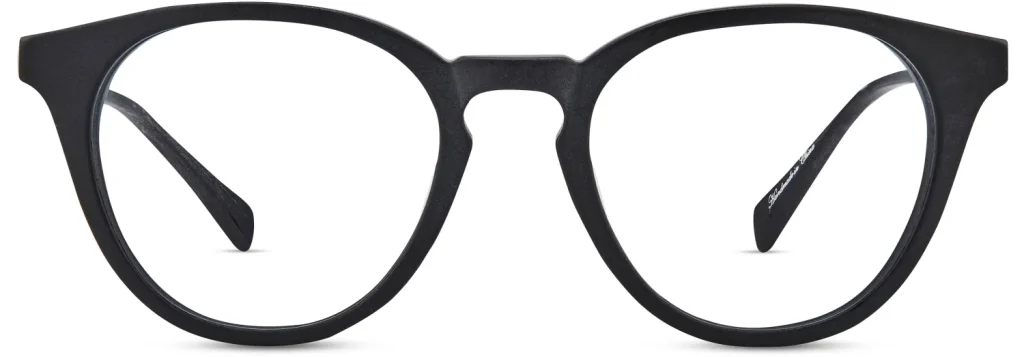
For those inspired by Spike Lee’s white Oakley smart glasses but looking for something more understated, the Merriam in Matte Black is the natural alternative. Where the Oakley leans into tech-forward bulk, the Merriam takes the same broad, Panto-influenced silhouette and refines it, slimmer temples, a more jewelry-inspired frame construction, and a matte finish that reads as quietly sophisticated rather than gadget-forward.
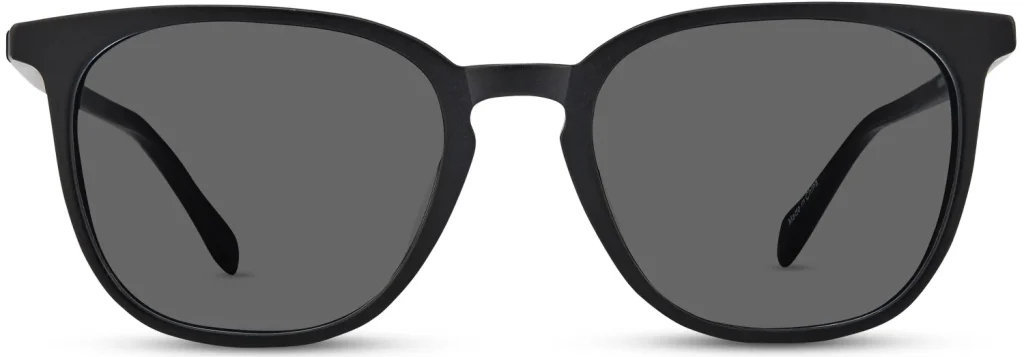
For those drawn to the bold acetate energy of Ryan Coogler or the strong, structured look of Amy Madigan, the Ashford offers a modern update on the oversized square frame. The key detail is the high-bridge design and the subtly upswept outer corners, which provide a visual lift to the cheekbones, a crucial consideration for round or oval face shapes that want the definition of a square frame without the heaviness that can sometimes drag the face down.
Final Thoughts
The 2026 Oscars made one thing undeniable: great eyewear is not about standing out for its own sake. The looks that resonated most, from Coogler’s architectural Matsuda to Chalamet’s precise Chrome Hearts, succeeded because the frames were chosen with an understanding of face shape, proportion, and how eyewear functions as a compositional element within a larger look.
That same philosophy, restraint, balance, and frames that genuinely fit the person wearing them, is what defines Classic Specs’ approach to design. Red carpet inspiration is most useful when it teaches you principles you can apply every day, not just rules you follow for one night. Choose frames that work with your features, commit to them with confidence, and the rest takes care of itself.
Interested in finding your perfect frame? Browse the full Classic Specs collection at classicspecs.com.